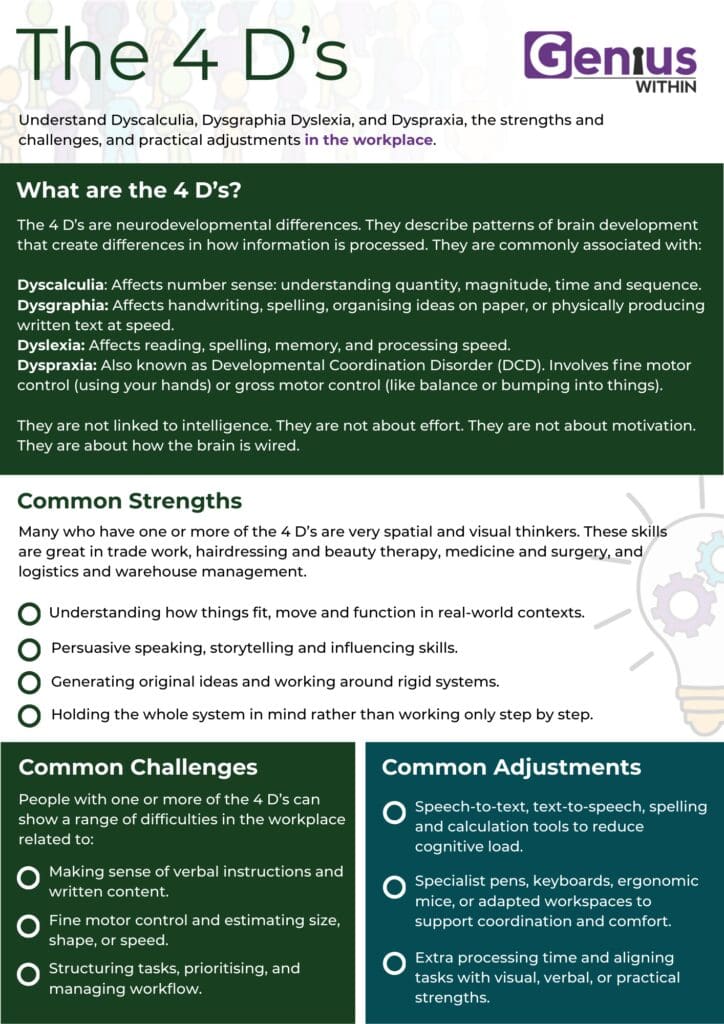
What do we mean when we say “the 4 D’s”?
We’ve grouped these together because they all relate to a very specific set of difficulties, which don’t affect the rest of someone’s thinking.
What all these neurological conditions have in common is that there are different patterns in the brain that lead to one or more difficulties in performing specific tasks. This is called an invisible disability, because we can’t see where it comes from. It is not obvious. There is no cast, no wheelchair, no visible marker. From the outside, someone may appear perfectly capable, and that is often why they are misunderstood.
The 4 D’s are neurodifferences. They describe patterns of brain development that create differences in how information is processed. They are not linked to intelligence. They are not about effort. They are not about motivation. They are about how the brain is wired.
What Does Each of the 4 D’s Mean?
Dyslexia
The dominant theory of dyslexia in the western world is to do with processing sounds. But dyslexia interacts with the language you speak. If you are an English-speaking dyslexic, then the verbal centres of your brain might show less activity, because English is a phonetic language, and a particularly inconsistent one. The same letter combinations can make different sounds, and the same sounds can be written in multiple ways.
If you are Italian or Finnish, the language has a much better correlation between sound and image, so you might learn to read and write more easily than an English-speaking dyslexic. However, if you are a Chinese-speaking dyslexic, then the visual centres of your brain might show less activity than the verbal. This is because Chinese is a visual language.
So dyslexia is not one single thing. It interacts with culture and language.
Other theories of dyslexia are not to do with processing sounds or images, but to do with memory, both short-term and long-term.
Some researchers say that dyslexics cannot hold enough detail in the short-term memory (for individual word sounds, for example) and therefore cannot learn them as easily. You might have heard a child pronounce a word completely wrong, like “bisghetti” instead of “spaghetti”, or “par cark” instead of “car park”. These are examples of not hearing the sounds correctly in the first place, and therefore not storing them accurately.
Other researchers have looked at the impact of internal balance on how we process 2D code. You need to feel still in order for shapes to stay still when you are reading them. If your balance system is slightly different, the letters on the page can appear unstable or harder to anchor.
Literacy is weird, let’s be honest. It’s only been around for 150 years in its current widespread form. Before that, we sang songs and told stories to commit information to memory. The human brain did not evolve specifically to read and write. It adapted to do so. For some brains, that adaptation is simply harder work.
Dyspraxia
Dyspraxia is also known as Developmental Coordination Disorder (DCD).
Dyspraxia can involve fine motor control (things you do with your hands) or gross motor control (like balance or bumping into things). It can affect driving, using tools, orientating yourself in a new place, judging distances, or coordinating speech.
Some people think dyspraxia comes from having left/right brain coordination difficulties. Others think it comes from having fewer sensory signals from the hands to the brain. And yet another school of thought is that it is about balance, and your sense of yourself within a space.
Dyspraxia can also affect sequencing – knowing what to do first, second and third. That might show up physically (tying shoelaces, learning dance routines) or cognitively (organising a workflow, structuring a document).
It is important to remember that dyspraxia is not clumsiness caused by carelessness. It is a neurological difference in how movement is planned and executed.
Dyscalculia and Dysgraphia
Dyscalculia and dysgraphia are much less well researched but have similar theories about origin.
Dyscalculia affects number sense. Understanding quantity, magnitude, time and sequence. It is not just “being bad at maths”. It can involve difficulty estimating, judging speed or distance, remembering number facts, or following multi-step calculations.
Dysgraphia affects writing. This can include handwriting, spelling, organising ideas on paper, or physically producing written text at speed. It is not simply messy handwriting. It is about how the brain coordinates language, planning and fine motor control.
You might learn how to cope with most tasks by practising over and over again, but learning something new can be difficult the first time. Like a new language, a new keyboard or new software. Once something becomes familiar, performance often improves dramatically.
Who is diagnosed?
Dyslexia affects up to 10% of the working population and that’s a very large number of people. Even if you think you are not working with dyslexic people, you probably are.
Dyscalculia is less prevalent, around 5% of the population, and similarly dysgraphia and dyspraxia, although they are both less well researched. As with most neurodifferences, the true numbers are likely higher than the diagnostic statistics suggest.
Diagnosis depends on awareness, access to assessment and cultural understanding. Many people were not identified in childhood. Some were labelled lazy, careless or disruptive instead.
The 4 D’s, like most neurodifferences, are overrepresented in unemployment, incarceration and exclusion from school. This is not because of lack of ability. It is because systems are designed around literacy, speed, handwriting and standardised testing.
There is nowhere near enough research on the benefits of the 4 D’s, but what research there is generally focuses on dyslexia. It shows that dyslexics are twice as likely to be entrepreneurs compared to neurotypicals, however only 1% of corporate managers are dyslexic.
This suggests something important about environment. When people can shape their own systems, they thrive. When they must fit into rigid systems, they may struggle.
Research points to talents in visual and mechanical reasoning (in the English-speaking world) and general creativity.
We don’t have equivalent data on the rest, but bear in mind that there are some mighty famous dyspraxic, dysgraphic and dyscalculic people, such as singers Robbie Williams and Florence (and the Machine) as well as Harry Potter himself, Daniel Radcliffe. Notably, those people all have high levels of verbal skills and the ability to connect to our emotions.
What are the strengths and struggles for people with the 4 D’s?
Remember that literacy, numeracy, handwriting and motor control are symptoms, not physiological causes.
As a result, people with one or more of the 4 D’s can show a range of difficulties in the workplace related to:
- Making sense of sound
- Processing written information
- Fine motor control
- Estimating size, shape and speed
- Sequencing and organisation
It doesn’t mean that they won’t be able to do it. It just might take a little bit more practice, repetition or adaptation.
There are also several underlying neurological processes that might cause difficulties.
Working memory
This is the part of the brain that holds on to details whilst trying to do something else.
Have you ever tried to remember a 6 digit multi-factor authentication code whilst typing it in? If you find this easy, congratulations! You have a strong working memory. If you find it hard, your working memory might be below average.
Working memory can affect:
- Following multi-step instructions
- Taking notes whilst listening
- Remembering names in meetings
- Holding numbers in mind
- Learning new systems
Annoyingly, working memory is made worse with age, illness, tiredness, long Covid, menopause and hunger.
For someone with one of the 4 D’s, working memory differences can amplify task difficulty. Especially when the task is new, unfamiliar or stressful.
Time management and organisation
Managing deadlines and being realistic about how long something will take can be a problem for the 4 D’s.
They might struggle to organise themselves, find it hard to identify where to start a task, or follow a workflow through to completion.
For dyslexics, this can be because they see the “whole picture” as one thing. Everything feels equally important.
For dyspraxics, this can be because they don’t see the whole picture at all. Sequencing can be harder.
This is not about lack of care. It is about how information is prioritised and structured in the brain.
Stress and masking
When people try to hide their differences and pretend that everything is fine, this is often referred to as masking.
Masking takes energy.
It can lead to burnout, anxiety, overload and emotional outbursts. It can also mean that difficulties are invisible until someone is already overwhelmed.
Because these are invisible differences, people are often judged before they are understood.
What about the strengths?
Visual skills
This covers all kinds of visual aspects, from being able to imagine what a completed product would look like whilst it is still in the planning stage, to being able to see exactly how a complex process works.
Many 4 D-ers are strong spatial thinkers. They can rotate objects in their mind. They can see patterns and connections that are not immediately obvious to others.
Practical skills
Who has ever struggled with a flat-pack furniture kit?
Imagine if that was easy, you didn’t even need the instructions.
This is your visual mechanical group – a very practical skill.
These colleagues can imagine how things ‘fit’. They can see patterns and abstract relationships in all kinds of places, not just engineering roles.
Practical skills are essential in:
- Construction
- Electrical work
- Painters and Decorators
- Plumbing
- Hairdressing and beauty therapy
- Medicine and surgery
- Logistics and warehouse management
These are not “less academic” skills. They are highly complex and valuable.
Creativity and speaking skills
From showing creative flair to having “the gift of the gab”, lots of 4 D-ers are great at presenting ideas and influencing others with their persuasive chat.
Because they have had to work around systems, they are often innovative thinkers.
These skills can be successfully deployed in:
- Management
- Sales
- Coaching and counselling
- Teaching
- Customer service
- Politics
Problem solving
Being able to visually think through a problem is a real asset for many 4 D-ers.
Seeing the whole system at once, rather than step by step, can lead to original solutions.
Great problem-solving skills are also likely to be why so many in this group are entrepreneurs.
Individual support
Technology is a great place to start for all of the 4 D’s.
Many of the difficulties relate to skills that are now supported by assistive technology, which can:
- Type for you
- Spell for you
- Read aloud to you
- Make calculations for you
- Measure size, shape and speed for you
This technology can help you move through written tasks much more quickly and with much higher accuracy, requiring less concentration and reducing stress levels.
Specialist assistive technology can also differentiate what you mean, for example, interpreting whether you meant weather (as in it’s raining outside) or whether (as in whether or not).
However, using specialist assistive technology is not like clicking your fingers.
You need to learn how to use it. The technology needs to be trained to support you properly. It takes time and effort. But research consistently shows that investing time in training leads to significantly better outcomes.
Dyspraxia-specific adaptations
For dyspraxic people, the way you introduce new locations, tools and software can be adapted to give them the best chance of success.
They might need to:
- Talk through directions
- Plan routes in advance
- Have their own map of a new building
- Practice navigating a system before being assessed on it
Ergonomic tools such as specialised pens or an ergonomic mouse, can help reduce strain and increase control.
If a new system changes layout completely, this can significantly slow adaptation. Extra time may be needed to rebuild spatial familiarity.
Working to strengths
Overall, the specific style of working through tasks should play to the strengths of the individual.
If they are strong in visual skills, mind mapping, colour coding and spatial layouts are helpful.
If they are strong in verbal skills, strategies that rely on rhythm, order, mnemonics and pre-programmed reminders can be effective.
Flow charts, overviews and bullet points are easier to digest than walls of text.
The goal is not to “fix” the person.
The goal is to reduce unnecessary friction, so that talent can show up more easily
Helping to find your Genius Within
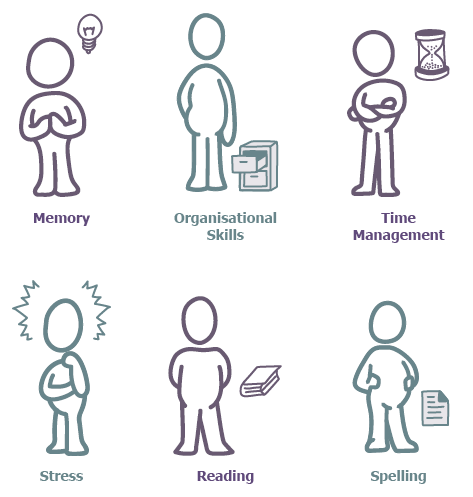
Our clients most commonly ask for help with the following areas:
- Memory
- Organisational skills
- Time management
- Stress
- Spelling
- Reading
We work with our clients to develop a bespoke plan that best matches their needs. This may include strategies on the above areas, or it might include other areas where they feel they need more support to work at their best.
Want to find out more?
Discover the GeniusFinder, the replacment to our previous Genius Screener or have a look at what services we offer.
Funding
You may be able to get funding through the Access to Work scheme. If you have funding, you can come straight to us, no matter who is recommended on the referral – it’s your choice! We are approved suppliers UK wide.