
Posted 06 Oct 2026
ADHD, Benefits and Work: It’s Time to Change the Conversation
Author Bio
This article is written by Genius Within Community Manager Helen Doyle. Helen is a subject matter specialist writing about neurodiversity and disability inclusion both from the perspective of her own lived experience and collaborating with the experts on our team to cover a wide variety of topics and views. Today she writes about ADHD and unemployment, seeking guidance on the subject from Genius Within Business Psychologist Gunjan Odedra.
Enough With the Never Ending ADHD Headlines
October is ADHD Awareness Month but somehow our media seems less aware than ever. Over recent months ADHD has frequently been a feature of the headlines for all the wrong reasons.
We have seen newspaper coverage questioning why so many young people with ADHD receive disability benefits, alongside political commentary suggesting conditions such as ADHD and anxiety are being used as an “excuse” not to work. One recent headline asked why “so many teenagers” are receiving benefits for ADHD, while other coverage has focused heavily on rising claims and their cost to the taxpayer. Many of the articles misrepresent the situation, failing to acknowledge that ADHD is frequently a co-occurring condition and the benefit recipients may be receiving higher amounts due to multiple disabling factors.
There is a legitimate conversation to be had about how our welfare system works and how we support more people into meaningful employment. But when that conversation portrays people with ADHD as choosing benefits over work, we risk confusing correlation with causation and reinforcing a stigma that already creates barriers.
The evidence tells a much more complicated story.
What the Employment Figures Actually Tell us
NHS England’s latest Adult Psychiatric Morbidity Survey found that 29.6% of unemployed working-age adults screened positive for ADHD, compared with 14.1% of those in employment. Economically inactive adults were also substantially more likely to screen positive. These figures do not mean that everyone who screened positive has an ADHD diagnosis, but they do demonstrate a striking association between ADHD characteristics and employment status.
Meanwhile, NHS estimates suggest that around 2.5 million people in England have ADHD, including many people who remain undiagnosed. NHS England’s independent ADHD Taskforce has also concluded that under-recognition of ADHD remains a problem, rather than finding evidence that the underlying prevalence of ADHD in the population is increasing.
Look beyond ADHD specifically and the employment inequality for disabled people in general is even clearer. In 2024/25, 29.6% of disabled young people aged 16 to 24 were not in education, employment or training (NEET), compared with just 8.7% of non-disabled young people (according to government data). Disabled young people were therefore more than three times as likely to be NEET.
These figures should make us ask a different question.
Instead of asking, “Why are so many people with ADHD claiming benefits?”, perhaps we should be asking, “Why are so many people with ADHD struggling to access and sustain employment?” or “Why is ADHD so disabling in education and work?”

ADHD is Impacted by Environment
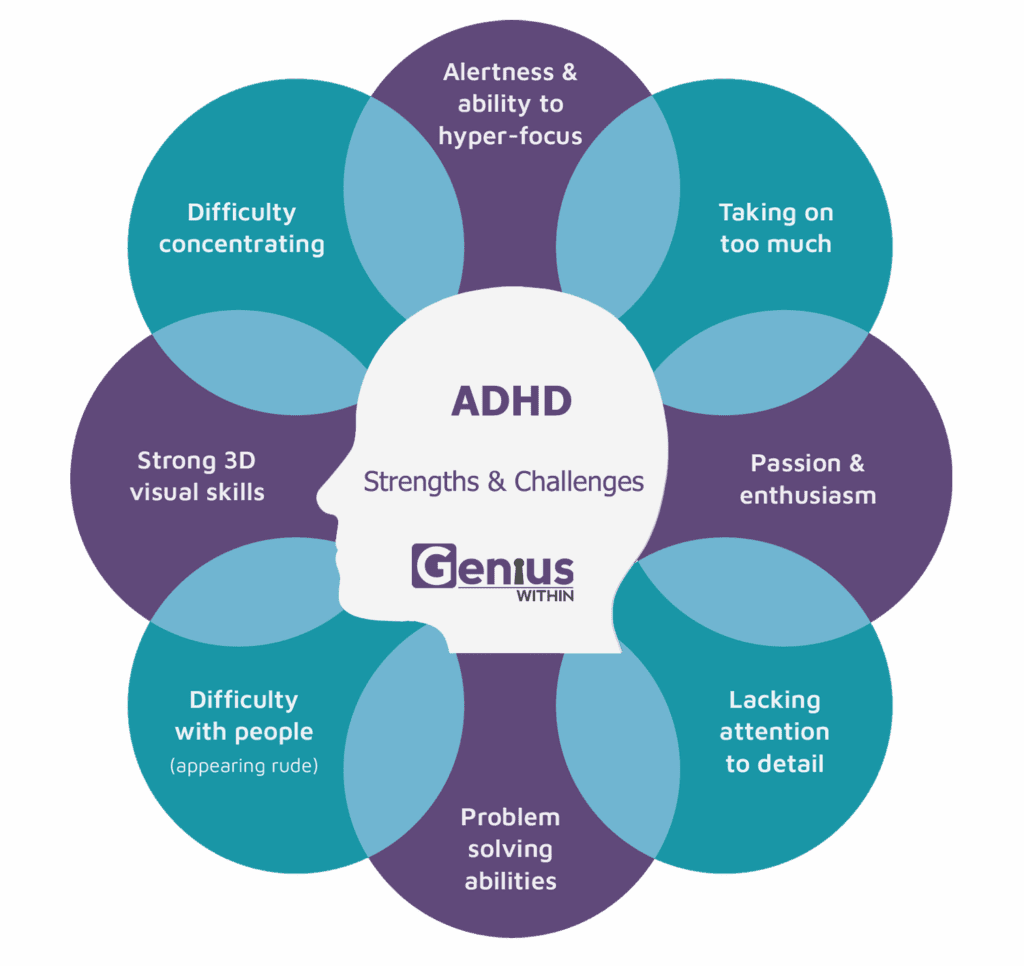
People with ADHD can bring enormous strengths to workplaces, including creativity, energy, curiosity, problem-solving, innovation and the ability to think differently.
But having strengths does not remove disability.
ADHD affects executive functioning, working memory, attention regulation, organisation, emotional regulation and time management. The impact varies considerably from person to person and can also change according to the environment they are in.
A workplace that relies on unclear expectations, competing priorities, constant interruptions or unspoken rules may create significant barriers for someone with ADHD. That same person might flourish in an environment where expectations are explicit, their strengths are recognised and appropriate adjustments are available.
If we genuinely want more people with ADHD to enter and remain in employment, tackling those barriers is far more productive than questioning their motivation.
What Can We Do Differently?
At Genius Within a large part of our work is in employability. We have supported many people with ADHD through the process of job-seeking and then beyond when needing to adapt to a new work environment. I asked one of our team members, Business Psychologist Gunjan Odedra, for her thoughts on what would make the most difference if we want to see more ADHD-ers successfully making the move from education/unemployment into work. She said:
Plan the transition into employment early. For young people leaving education, conversations about strengths, support needs and adjustments should happen before they start work, not after something has gone wrong. Structured onboarding and continuity of support can make an enormous difference.
Provide structure and clarity. Clear written instructions, manageable deadlines, defined priorities, reminders and regular check-ins can support executive functioning, organisation and time management. Many of these approaches make work easier for everyone, not only colleagues with ADHD.
Offer personalised support. There is no single “ADHD adjustment”. Flexible working, assistive technology, mentoring, job coaching or reducing environmental distractions may help, depending on the individual and their role.
Build ADHD-aware workplaces. Managers need the confidence to talk about barriers and support without making assumptions about capability. Psychological safety matters too. Employees should be able to discuss what helps them work effectively without feeling pressured to disclose a diagnosis.
Think beyond recruitment. Getting someone into a job is only the beginning. Sustainable employment requires support with retention, skills development and career progression. Government schemes such as Access to Work can provide practical workplace support for people with ADHD, and importantly, a formal diagnosis is not necessarily required to apply.

Change the Environment and Drop the Stigma
There should absolutely be ambition to reduce economic inactivity and help more people into fulfilling, sustainable work.
But stigma will not achieve that. We have got to change the conversation and stop the never ending clickbait that invalidates and vilifies people with ADHD.
If ADHD-ers are disproportionately represented among those who are unemployed, the answer is not to assume they lack aspiration. It is to understand the barriers that are preventing people from entering workplaces, staying there and progressing.
The better question is not whether people with ADHD should work.
It is whether we are doing enough to make work work for them.
To learn more about ADHD click here.
For more articles on the subject of ADHD, click here.