
What is ADHD?
ADHD stands for Attention Deficit Hyperactivity Disorder.
Around 5% of adults are currently diagnosed with ADHD. However, this figure is likely an underestimate. Many people were not diagnosed in childhood, and long diagnostic waiting lists mean some studies suggest the true prevalence may be closer to 8–10%.
Some people are diagnosed without visible hyperactivity. This is sometimes referred to as ADD (Attention Deficit Disorder). However, it is important to understand that not all hyperactivity is obvious.
Hyperactivity is often misunderstood as large, disruptive behaviour. In reality, it may show up as much smaller movements that are easy to miss, such as:
- Repeated tapping
- Twiddling hair
- Chewing or biting nails
These subtler forms of hyperactivity are more commonly seen in girls, which is one reason fewer girls are diagnosed. Their differences are less likely to be noticed or taken seriously.
How ADHD works
There is no single cause of ADHD. Different factors may contribute for different people.
Neurotransmitters
One explanation relates to the brain chemicals dopamine and noradrenaline (also called norepinephrine).
Dopamine helps us feel satisfied and engaged. Noradrenaline plays a role in our stress response and helps us think clearly in a crisis.
Many ADHDers have lower baseline levels of these neurotransmitters. This can make it harder to stay focused on everyday tasks that feel boring or repetitive. However, attention may switch on very strongly when something is new, urgent, or needs solving.
From a population perspective, this difference makes sense. Humans benefit from having people who are alert to change, responsive under pressure, and able to think quickly in challenging situations.
Sleep
ADHDers often have later sleep cycles than non-ADHDers. Trying to fit these natural rhythms into a standard working week can result in chronic sleep deprivation, which in turn affects focus, emotional regulation, and energy levels.
Working memory
Many ADHDers experience differences in working memory. This is the mental system that allows us to hold information in mind while using it.
For example:
- Remembering a phone number while looking for your phone
- Doing calculations in your head
Most people can hold between five and nine pieces of information at once. Many ADHDers can hold fewer, unless a task is particularly interesting or urgent.
This can lead to large swings between high and low performance, which can feel frustrating and confusing until patterns are understood.
Who is diagnosed with ADHD?
Diagnosis rates vary widely across countries. ADHD is diagnosed more frequently in the USA than in Japan, for example. This is likely influenced by culture.
In cultures that value politeness, deference to authority, and conformity, ADHDers may be more likely to mask their differences. In cultures that encourage expressiveness, differences may be more visible and more readily diagnosed.
When ADHD is identified in childhood, more boys than girls are diagnosed. This is partly due to gender norms. Girls are often punished more harshly for acting out, and their behaviour may be interpreted differently. Many are misdiagnosed with anxiety or personality disorders.
People who are marginalised by race or poverty are also at higher risk of misdiagnosis, often receiving labels such as conduct disorder instead.
ADHD is overrepresented in some settings and underrepresented in others:
- Around 25% of people in UK prisons meet the clinical threshold for ADHD
- ADHDers who complete education are around 50% more likely to start a business than non-ADHDers
Finding work that aligns with interest and passion is often key to long-term success.
ADHD and medication
Unlike some other neurodifferences, ADHD can be treated with medication.
This can raise questions within the neurodiversity movement, which emphasises difference rather than deficit. However, medication does not “fix” a person. Most ADHD medications work by increasing dopamine and noradrenaline, helping people feel calmer, happier, and clearer in their thinking.
Some ADHDers find medication life-changing. Others prefer not to take it.
Exercise, fulfilling work, and supportive relationships can also increase dopamine. However, not everyone has equal access to these supports, and not everyone experiences the same level of difficulty.
Choosing whether to use medication is deeply personal, and people should not be judged for taking it or not taking it.
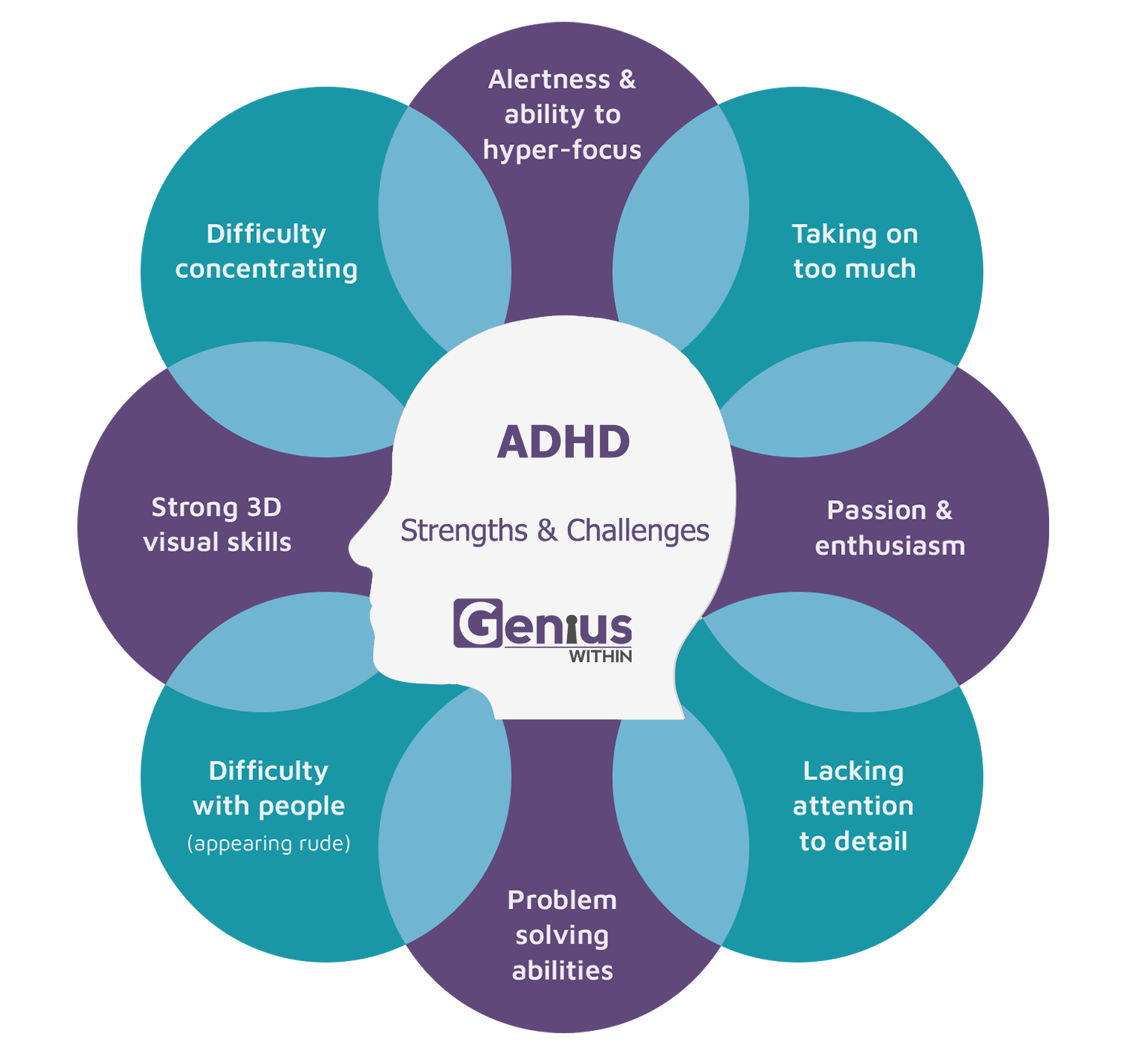
Strengths and challenges of ADHD at work
At work, ADHDers may experience cycles of intense productivity followed by periods where they need rest and recovery.
They may:
- Lose track of discussions in meetings
- Struggle to hold multiple pieces of information in mind
- Find open-plan offices distracting, especially for detailed or technical work
- Experience challenges with emotional regulation, which can be misinterpreted as bluntness or rudeness
At the same time, ADHD is strongly associated with:
- Creativity
- Passion
- Courage
- Generating ideas and new approaches
These strengths are particularly valuable in roles involving inspiring, motivating, teaching, coaching, or selling.
Workplace adjustments and support
Support for ADHD at work often centres on flexibility, rather than rigid rules.
Individual strategies
Many ADHDers benefit from assistive technology, such as tools that read text aloud, making it easier to spot missing words or overly long sentences.
Traditional advice like “just write a list” is often unhelpful. Alternatives may include:
- Visual planning, such as mind maps
- Using post-it notes to organise tasks spatially
- Digital tools, used carefully to avoid creating extra admin
Feedback and communication
Feedback flexibility is important.
ADHDers may not automatically notice how their communication is landing. Clear, practical feedback that focuses on what to do differently next time is often far more effective than blame.
Giving the benefit of the doubt matters. ADHDers are rarely intending to offend and may feel distressed if they believe they have upset someone.
For ADHDers receiving feedback, a useful question can be:
“What would you prefer me to do next time?”
Environment and scheduling
Environmental flexibility can make a significant difference, such as:
- Using noise-cancelling headphones
- Booking quiet spaces for detailed work
Schedule flexibility is also highly effective. Many ADHDers work best in bursts, with variable energy levels. Longer days when energy is high and shorter days when it is not can support sustainable performance.
Rejection Sensitive Dysphoria
Some ADHDers experience Rejection Sensitive Dysphoria (RSD).
RSD refers to an intense emotional response to perceived criticism, rejection, or failure. The reaction is not a choice, and it is often out of proportion to the situation, even when the person logically understands that no harm was intended.
RSD is linked to differences in emotional regulation, which are common in ADHD. It can be triggered not only by direct feedback, but also by:
- A change in tone
- A delayed response to a message
- Feeling ignored or excluded
- Ambiguous or unclear feedback
Because the reaction is internal, RSD is often invisible to others. What may be seen instead is withdrawal, people-pleasing, defensiveness, or strong emotional responses that seem unexpected.
RSD at work
In the workplace, RSD can affect:
- How feedback is received
- Confidence in meetings
- Willingness to share ideas
- Risk-taking and innovation
An ADHDer may replay interactions repeatedly, assume negative intent, or feel overwhelming shame after relatively minor comments. This can be exhausting and may contribute to burnout if not understood.
At the same time, the sensitivity associated with RSD often sits alongside high empathy, strong values, and deep commitment to work that matters.
Supporting RSD at work
Support for RSD does not require avoiding feedback. Instead, it benefits from clarity, predictability, and psychological safety.
Helpful approaches include:
- Giving feedback that is specific, concrete, and balanced
- Separating behaviour from intent
- Explaining what to do differently next time, rather than focusing on what went wrong
- Avoiding vague or ambiguous criticism
Trust and consistency matter. When ADHDers understand expectations clearly and feel safe to ask for clarification, the impact of RSD is often reduced.
Important note: RSD is not a formal diagnostic category, but it is a widely reported and clinically recognised experience among ADHDers. Not everyone with ADHD experiences RSD, and those who do experience it to different degrees.
In summary
ADHD is a common neurodifference that affects attention, energy, and working memory.
Not everyone with ADHD experiences hyperactivity in the same way, and some hyperactivity is subtle and easily missed.
Some people choose medication to support their ADHD and others do not. Both choices are valid.
ADHDers can be highly creative, resourceful, and effective under pressure.
Workplace adjustments that focus on flexibility, feedback, and environment can make a meaningful difference.
Funding
You may be able to get funding through the Access to Work scheme. If you have funding, you can come straight to us, no matter who is recommended on the referral – it’s your choice! We are approved suppliers UK wide.