
Posted 27 Nov 2025
Richard Tice Is Wrong: Blocking Headphones in Schools Undermines His Own Claims About Reducing Welfare Spending
Richard Tice, deputy leader of Reform UK, labelling the use of ear defenders by children in classrooms as “insane”. Arguing that special educational needs, particularly diagnoses such as ADHD, are overused and that support should be limited. On the surface it sounds like another culture war comment. But look a little closer and something does not add up.
Tice and his party argue that the country spends too much on benefits and disability support. They say too many adults are out of work and relying on public money. Yet at the same time, Tice dismisses the exact support that prevent children from becoming adults needing those benefits. It is a perfect example of wanting the outcome without supporting the process that leads to it.
Support Now Or Support Later?
His comments are not just dismissive. They reveal a deeper contradiction at the heart of his political messaging. By attacking tools that neurodivergent children rely on, he undermines his own position on reducing state dependency in adulthood.
Opposing low-cost educational accommodations while also arguing against long term benefits spending is logically inconsistent. If children do not receive the support they need, they are more likely to struggle later, increasing their reliance on state funded services.
Children who do not get the accommodations they need at school do not magically stop being neurodivergent. They just learn that the world is not built for them. If children don’t learn to self-advocate or regulate, they’re much more likely to struggle socially and emotionally later. Leading to mental health issues, social exclusion, burnout, and in some cases, interactions with the criminal justice system or homelessness. Children move into adulthood with untreated needs, which costs the system far more than a pair of headphones ever would.
So if the political goal is to reduce long term benefit spending, helping kids succeed early is the smartest investment. Removing accommodations is not tough love. It is short sighted and expensive.
Teaching Self-Advocacy: Building Stronger Employees
Across multiple sectors, workplaces still lag behind in creating inclusive environments. Noise sensitivity is one of the most common barriers reported by neurodivergent workers. Commonly in open plan offices or environments with unpredictable sound. Yet many adults remain reluctant to disclose their needs because they fear negative judgement or career penalties.
This reluctance is learned. If children are told that wearing headphones is “insane,” they internalise the idea that managing sensory overwhelm is something shameful. Helping children grow comfortable with the tools that support their productivity influences their comfort in seeking support later on.
Neurodivergent employees are struggling not because of ability, but because they feel uncertain about asking for adjustments. Many adults with sensory or attention related differences do not know what would help them. They were never encouraged to experiment with accommodations in school. They were never shown that asking for support is acceptable.
When employees are struggling and managers don’t know why we end up with a cycle of underperformance, frustration, and withdrawal. Useful skills are going unused and company time being lost to a problem with a simple and inexpensive solution.
Sensory accommodations like headphones are a simple tool that help children practice identifying what works for them. This is not coddling. It is preparation for the workforce.
Headphones Represent Progress, Not Decline
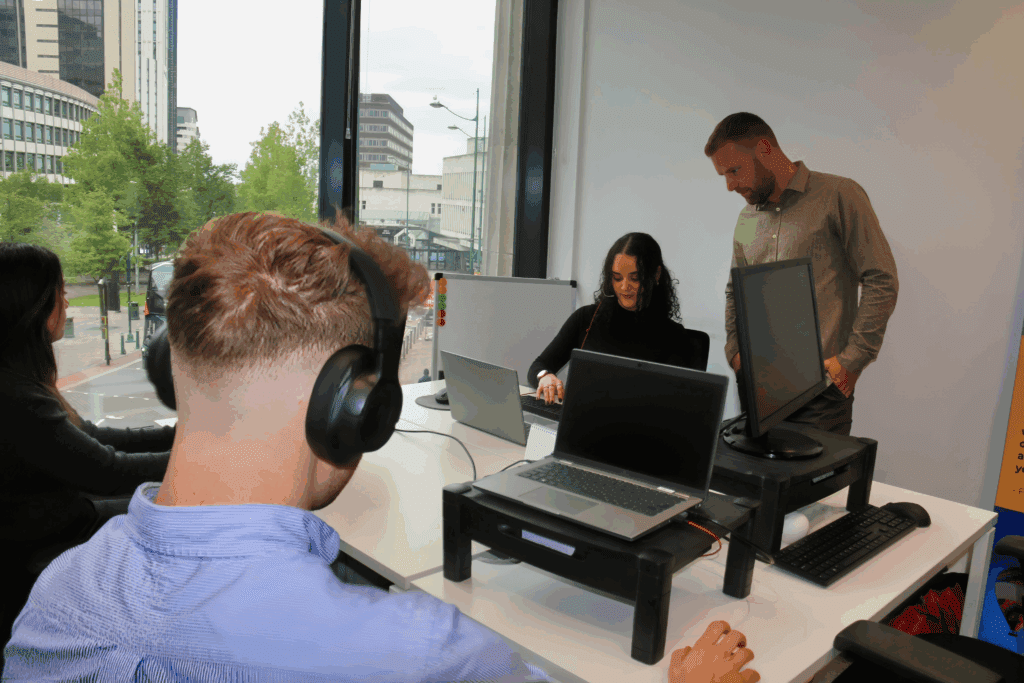
Headphones in classrooms reflect a maturing understanding of neurodiversity. They are not toys. They are the equivalent of the quiet rooms, soundproof pods, flexible seating arrangements, and noise reducing technology. Many progressive employers invest in these today. The goal is not to create perfectly equal environments, but to create equitable ones. Ones where everyone can access the conditions under which they do their best work.
Imagine joining a company where your colleagues have an office with four walls and a door while you are expected to work from the building site next door. Would it be reasonable to expect the same focus and output from you? Most people would agree this is both unfair and absurd. Yet this is precisely the situation many neurodivergent children face when they are denied basic sensory accommodations in school. If we want a world in which this person would inevitably be fired for poor performance, then we can’t complain about their need for state support. It is morally inconsistent.
Headphones are not the problem. Schools adopting headphones, fidget tools, and relaxed uniform policies is not a step backwards. It is catching up. And if the end goal is a strong workforce, then showing children that they can shape their environment instead of suffering through it is one of the most useful lessons they will ever learn.
The contradiction is the whole story
Richard Tice cannot have it both ways. You cannot wish to cut state spending while also fighting against the educational supports that reduce the need for adult services and benefits. You cannot claim to prepare children for the world of work while refusing them the very tools that help them participate. And you cannot call headphones “insane” when they are one of the simplest, cheapest and most effective ways to level the playing field.
If we are serious about building a strong, independent workforce, then supporting neurodivergent children is not optional. It is the foundation.